
Google Search Console Links Report Broken
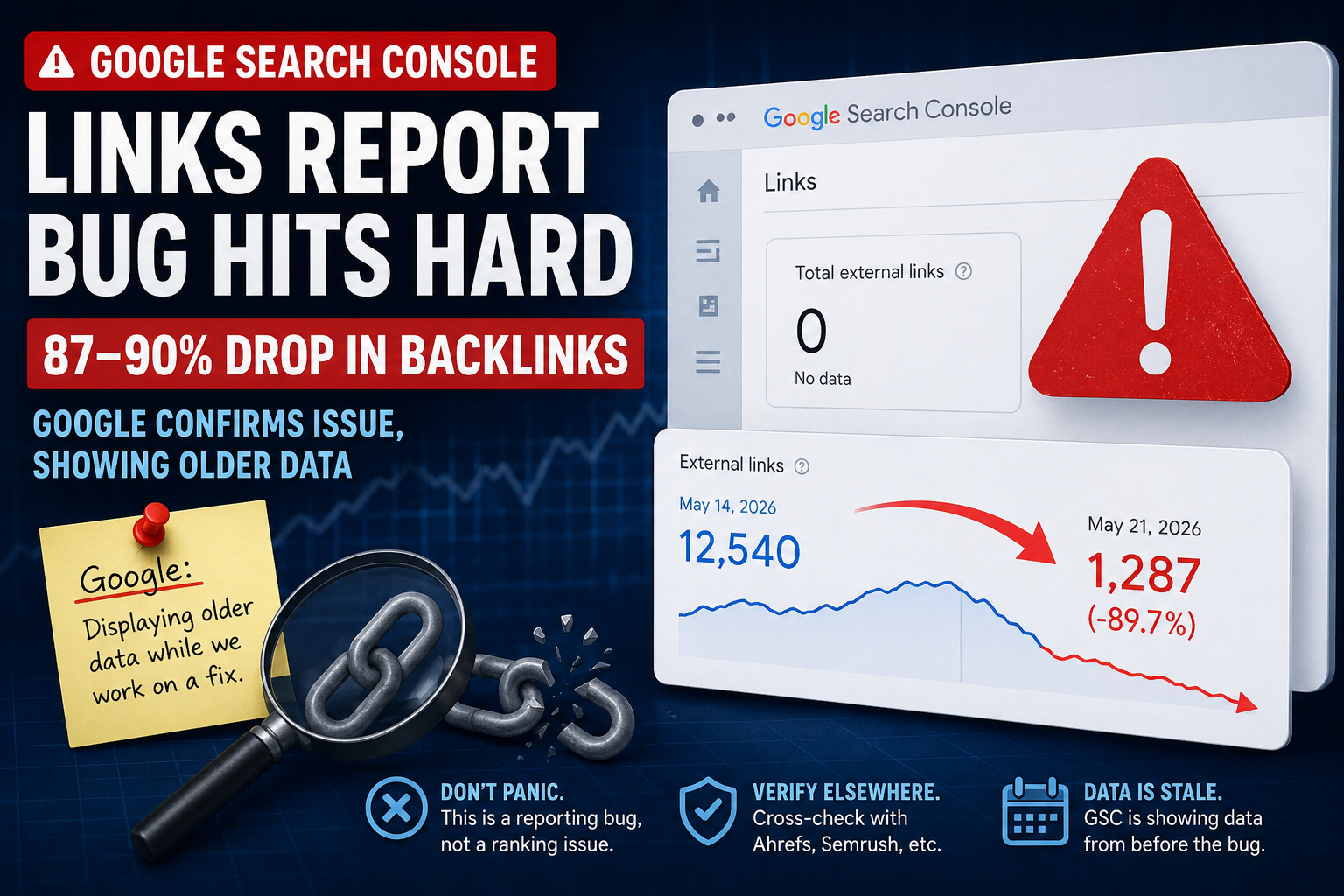
Something went quietly sideways in Google Search Console last week, and if you were the type to check your Links report on the morning of May 21, 2026, you probably had a small heart attack. Hundreds of SEOs woke up to either zero links in the report or an 87–90% collapse in the number of backlinks Google said they had practically overnight.
To be clear upfront: this is a Google bug, not a ranking signal. If your links disappeared from the report, your site wasn’t penalised, your backlinks weren’t devalued, and Google hasn’t turned against you. The reporting layer broke. That’s it. Here’s everything you need to know.
What Happened The Short Version
On May 21, the Google Search Console Links report went haywire. For many users the report showed zero external links. For others, the count dropped by nearly 90% compared to the week before. Barry Schwartz at Search Engine Roundtable was among the first to document the issue publicly, reporting an 87.5% drop in reported links for his own site.
Multiple well-known SEOs quickly corroborated it on social media. Glenn Gabe, a respected search analyst, posted screenshots showing the collapse across client accounts. The consensus was fast: something had broken at the infrastructure or data-pipeline level inside Google Search Console.
What Google Said About It
John Mueller from Google was fairly quick to acknowledge the issue. His initial response: Google would investigate, though he flagged that with a long weekend involved it might take a little time.
By Saturday, the links appeared to return — but that was only a temporary fix. Mueller clarified that Google’s team had simply switched the report back to data from the previous week while engineers worked on resolving the actual underlying problem.
Google’s current position: The Links report in Search Console is displaying older data — from before the bug occurred — while the fix is in progress. The data you see right now is not current. It is a placeholder from the week prior.
There is no confirmed ETA for when the live, accurate links data will be restored.
What It Actually Looked Like
To understand the scale of the issue: some SEOs opened the Links report to find it completely empty — no external links at all, as if the site had never existed on the web. Others saw massive drops. Not 10% or 20%. We’re talking 85% to 90% collapses in reported link counts versus the prior week’s snapshot.
Third-party backlink tools (Ahrefs, Semrush, Majestic) showed no corresponding changes. Organic rankings and traffic remained stable. Impressions and click data in the Performance report were unaffected. Every signal pointed to a Search Console reporting anomaly, not a genuine change in how Google evaluates the sites.
What You Should (and Shouldn’t) Do
DO NOT panic or react to the data
This is not the time to disavow links, cancel backlink-building campaigns, or pull publisher placements. The Links report is a reporting tool, not a live signal feed, and this episode is a reminder of its limitations. A collapse inside one interface does not mean Google suddenly dropped your authority.
DO treat the current data as stale
If you’re preparing client reports or stakeholder presentations this week, note clearly that the Links data is from the week before the bug, not the current state. Google has acknowledged this and it is the right framing for any reporting.
DO verify using third-party tools
If a client or manager is pressing you on the link drop, cross-reference with Ahrefs or Semrush. If their data is stable, there is no real-world link issue. The GSC bug is isolated to Google’s own reporting interface.
More From Opositive: Related GSC & Google News
This is not the first time Google Search Console has served up confusing or broken data this year. Earlier in 2026 we covered a GSC bug linked to the March 2026 Core Update, where reporting inconsistencies were flagged alongside ranking volatility — and John Mueller stepped in on that one too.
Speaking of volatility, if you’ve been noticing unstable rankings in recent weeks, you’re not alone. We reported on a significant wave of Google Search Ranking Volatility around Google I/O 2026 — a pattern that tends to make any anomaly in Search Console feel far more alarming than it actually is.
The Google May 2026 Core Update is also currently rolling out. If you’re trying to separate genuine ranking shifts from reporting noise, that piece is worth reading alongside this one.
And for the SEOs keeping an eye on de-indexing patterns, we’ve been tracking a worrying trend separately: Google is removing URLs from its index at a record rate in 2026. That’s a real, documented story — this Links report bug is not.
On a related note, Google has also been quietly strengthening its grip on Search Console as a communication channel. The back button hijacking warning notices sent via Search Console earlier this year are a reminder that GSC is increasingly the first place Google tells you something is wrong — which makes a broken reporting tool all the more frustrating.
Opositive Take On the News
Every time a Google reporting tool misfires, it exposes something uncomfortable: a lot of SEO decision-making runs on data that is already sampled, lagged, and incomplete. The Links report in particular has always been more of a directional signal than a precise database. Most practitioners know this. But clients, stakeholders, and junior team members often don’t.
The real problem here is not the bug — Google breaks things, acknowledges it, and fixes it. That’s a normal engineering cadence. The real problem is that when a single number in a single tool collapses by 90%, even experienced SEOs feel the pull to do something. To react. To protect.
Resist that pull. The discipline of checking multiple data sources before acting is what separates good SEO from expensive overreactions. In this case the answer was available quickly: rankings stable, traffic stable, third-party tools stable. One broken report does not a crisis make.
What this incident should accelerate is a broader conversation about not relying on Search Console as a single source of truth for link data. If your reporting workflow depends entirely on GSC Links numbers, this week is a good reason to diversify that dependency — not in a panic, but as a structural improvement.
We’ll update this story when Google confirms the fix is fully deployed and accurate data is back in the report.