
Adding Schema Markup Didn’t Increase AI Citations, Ahrefs Finds
Here’s something that’ll make a lot of SEOs uncomfortable: adding JSON-LD schema to your pages probably isn’t moving the needle on schema markup AI citations. That’s the headline finding from a large-scale Ahrefs study that tracked nearly 1,900 pages across three major AI platforms, and the results were, to put it mildly, pretty flat.
This doesn’t mean schema is useless- far from it. But it does complicate a narrative that’s been circulating in SEO circles for the past year or so: the idea that structured data is a reliable lever for getting your content surfaced in AI-generated answers. The data suggests that’s not quite how it works.
What the Ahrefs Study on Schema Markup AI Citations Actually Tested
The Ahrefs report started with a genuinely interesting observation. After analyzing 6 million URLs, the team found that pages cited by AI were nearly three times more likely to have JSON-LD than pages that weren’t. On the surface, that looks like a strong case for schema. But Ahrefs didn’t stop there. They wanted to know whether schema was actually causing those citations or whether it was just tagging along with other signals like content quality, authority, and backlinks.
So they ran a controlled experiment. They tracked 1,885 pages that added JSON-LD schema between August 2025 and March 2026, matching each one against three control pages from different domains with similar citation histories that never added schema. Citation changes were measured 30 days before and after the schema addition across Google AI Overviews, Google AI Mode, and ChatGPT.
The Schema Markup AI Citations Numbers: What Each Platform Showed
None of the three platforms showed a meaningful increase in citations after schema was added. Here’s how it broke down:
- Google AI Overviews: −4.6% – a small but statistically notable decline relative to controls
- Google AI Mode: +2.4% – too small to distinguish from random variation
- ChatGPT: +2.2% – too small to distinguish from random variation
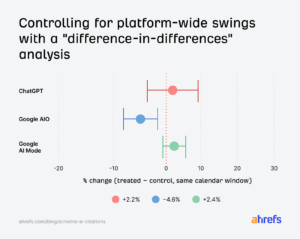
Three additional tests were run alongside the primary one, and all four came back with the same conclusion: no clear positive or negative effect. The schema markup AI citations relationship, at least for pages already visible to AI, appears to be essentially neutral.
About That Google AI Overviews Decline
The −4.6% figure for AI Overviews is the most eyebrow-raising number in the report, but Ahrefs is careful not to overinterpret it. Both the treated pages and control pages were already declining in AI Overview citations before schema was added. The pages that added schema just declined slightly faster. The actual difference worked out to roughly 12 fewer daily citations per page in a sample where most pages were already seeing hundreds – statistically notable, but not dramatic in practical terms.
Could it mean schema has a small negative effect on AI Overviews? Maybe. Could it be coincidence? Also possible. Ahrefs doesn’t draw a firm conclusion either way, and honestly that’s the right call given the data.
Why the Correlation Exists If Schema Isn’t the Cause
This is the part that matters most for how you think about schema going forward. The reason pages with schema are cited more often by AI isn’t because the schema itself triggered the citations, it’s because sites that implement structured data tend to also do everything else well. They publish stronger content, build more authority, earn more links, and maintain their technical setup properly. AI systems are more likely to surface that kind of content anyway. Strip the schema out and those signals still carry the page.
In other words, schema is a marker of site quality, not the engine driving it. That’s a meaningful distinction if you’re deciding where to invest your time and resources. If you’re already doing the foundational work — strong content, solid authority, good technical SEO – JSON-LD probably won’t be the unlock for schema markup AI citations on pages already in the consideration set.
What the Schema Markup AI Citations Study Couldn’t Measure
There’s an important caveat here that Ahrefs acknowledges openly. Every page in this dataset already had over 100 AI Overview citations before any schema was added. These were pages AI systems were already crawling and surfacing. The study says nothing about whether schema helps pages that aren’t yet on AI’s radar, that’s a genuinely different question that needs a different study.
There’s also the question of what AI systems actually do with schema at retrieval time. A separate experiment cited in the report tested whether five AI systems used schema markup when fetching pages in real time – none of them did. They only extracted visible HTML, ignoring JSON-LD, Microdata, and RDFa entirely. That’s a direct-fetch test rather than proof about training or indexing, but it’s still telling.
So Should You Still Use Schema?
Yes, just not for the reason you might have been sold on. Schema still delivers real value for rich results, voice search, knowledge graphs, and downstream entity recognition. It’s good infrastructure. What it isn’t, based on this data, is a reliable dial you can turn to improve schema markup AI citations on pages already visible to AI. If you want to understand how AI crawlers interact with your site more broadly, our piece on managing AI crawlers in your technical SEO audit goes deeper on the signals that actually matter.
The bigger picture here is that AI citation visibility is earned through content quality, topical authority, and how well your pages answer real questions, not through markup alone. If you’re still building out your understanding of why AI citations matter for SEO in 2026, that’s a good place to start before deciding where structured data fits into your strategy.
The Ahrefs study is one of the most rigorous pieces of research on schema markup AI citations published to date. It doesn’t close the book on structured data, but it does close the chapter that said JSON-LD is a shortcut to AI visibility. It isn’t. And the sooner SEOs stop selling it that way, the better.