
Google March 2026 Core Update Is Now Complete: The Important Impact on Your Site
Google has officially wrapped up the Google March 2026 Core Update, and if you’ve been keeping a close eye on your rankings or traffic over the past two weeks, now is the time to sit down and review your data properly.
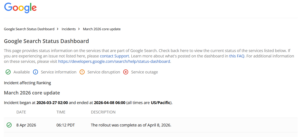
According to the Google Search Status Dashboard, the Google March 2026 Core Update rollout completion was confirmed at 6:12 AM PDT on April 8, 2026. The update had started on March 27 at 2:00 AM PT, putting the total deployment window at 12 days – right within Google’s estimated two-week window, and notably faster than the Google December Core Update 2025, which stretched across 18 days before wrapping up.
The screenshot of the updated dashboard:
What Google Actually Said About the Google March 2026 Core Update
Google described this as a routine algorithmic update: one designed to “better surface relevant, satisfying content for searchers from all types of sites.” No companion blog post was published, and no new guidance was issued alongside the completion notice.
That’s fairly standard. Core updates aren’t surgical strikes against particular types of content or policy violations. They’re broad recalibrations of Google’s ranking systems, meaning pages across the web can move up or down based on how Google now assesses overall content quality.
If your rankings dipped, that doesn’t mean you broke any rules. It simply means other pages may have been judged as more useful or relevant for certain queries.
March 2026 Saw Three Separate Google Updates: Here’s the Full Timeline
What made March 2026 stand out wasn’t just this core update – it was how many updates happened in a compressed window of roughly five weeks.
First came the February Discover Core Update, which finished on February 27 after a 22-day rollout. It was historically significant as the first time Google publicly labelled a core update as Discover-only.
Then came the March 2026 Spam Update, which launched on March 24 and wrapped up the very next morning – completing in under 20 hours. For context, the August 2025 spam update had taken 27 days. This one was lightning fast. You can read more about how it unfolded in our earlier coverage: March 2026 Spam Update Completed in Record Time.
Two days later, the Google March 2026 Core Update began its rollout on March 27.
The back-to-back sequencing of a spam update followed closely by a core update has drawn attention from SEO analysts. The theory is that it wasn’t coincidental – clearing out spammy content first essentially “prepares the ground” before the broader quality signals in a core update are reassessed.
How to Analyse Your Site’s Performance After This Update
Now that the rollout is fully done, you can run a proper before-and-after comparison in Google Search Console. Google recommends waiting at least a full week post-completion before drawing any firm conclusions – which means you’re looking at data from mid-April onward for reliable insights.
Your comparison window should be the weeks before March 27 versus performances after April 8. One thing worth keeping in mind: because the spam update also completed on March 25, any ranking shifts between March 24–27 could potentially belong to either update.
If your rankings fell, the advice from Google hasn’t changed. Focus on content quality, depth, and user satisfaction- not quick technical patches. As we’ve covered before in our breakdown of how Google core updates focus on long-term data, smaller tweaks rarely move the needle unless they’re part of a sustained quality improvement effort.
What to Expect Going Forward
The Google March 2026 Core Update being complete doesn’t mean things go quiet. Google updated its core update documentation in December to clarify that smaller, unannounced core changes happen continuously in the background. The major confirmed rollouts are just the visible tip of a much larger and ongoing process.
Keep monitoring your Search Console data, stay consistent with your content strategy, and don’t make panic-driven changes based on early data. Give it at least another week before treating any shifts as final signals.