
Google Search Live Is Now Global: What the Worldwide AI Mode Rollout Means for Search in 2026
If you have been following the trajectory of AI-powered search over the past twelve months, this one lands exactly where you would have expected — but the speed of it still matters.
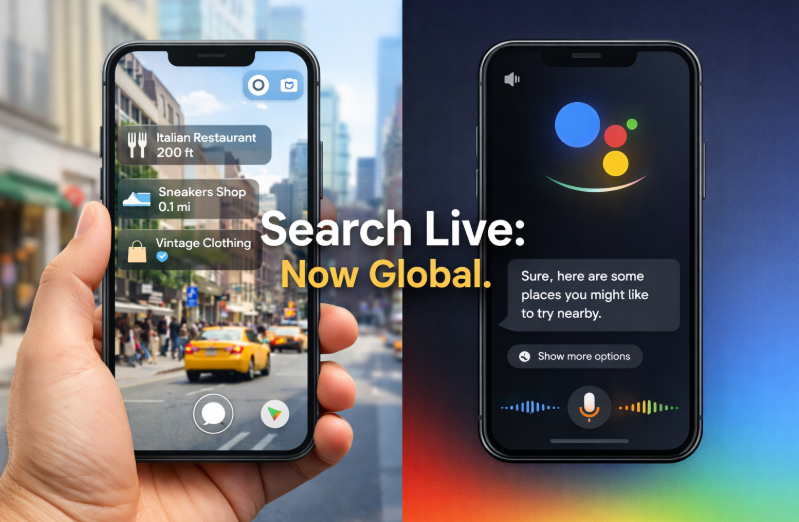
Google has officially rolled out Search Live to more than 200 countries and territories. The feature, which lets users point their phone camera at the world around them and hold a live voice conversation with Google Search, is no longer a US-and-India exclusive. As of late March 2026, it is available to virtually every user in every market where AI Mode has been enabled.
Powering the expansion is a new model: Gemini 3.1 Flash Live. Google describes it as its highest-quality audio and voice model to date — built from the ground up to handle real-world conversations with less latency, better noise filtering, and support for more than 90 languages. For the SEO industry, this is not a product launch story. It is a signal about where search is heading and how fast that shift is now moving.
What Search Live Actually Does
Search Live is not a rebrand of Google Lens. It is something structurally different. Where Lens provides a static visual identification — point, identify, done — Search Live enables continuous, multi-turn dialogue anchored to what the camera sees.
A user can point their phone at a restaurant menu and ask about allergens in a specific dish. They can follow up with questions about nearby alternatives. They can shift the camera to a wine bottle and ask for pairing suggestions — all within the same uninterrupted conversation, without typing a single character. The experience is built directly into the Google app on both Android and iOS. Users access it by tapping the Live icon beneath the search bar.
Google stated in its announcement that Search Live is designed for moments when real-time help is needed and typing simply is not practical. That framing is telling. It positions the feature not as a novelty but as a functional upgrade to how search behaves in everyday, real-world situations.
🔗 Search Live sits within the broader AI Mode expansion Google has been building. It is worth understanding the full picture: Google Is Testing AI Mode Directly in the Search Bar — because Search Live and AI Mode are converging into a single, more powerful discovery layer.
Gemini 3.1 Flash Live — The Engine Behind the Expansion
The global rollout of Search Live would not have been possible without a meaningful model upgrade. Gemini 3.1 Flash Live is the infrastructure behind both the consumer-facing Search Live experience and the Gemini Live voice assistant on Android.
Three capabilities stand out as practically significant for understanding what this model enables. First, it filters background noise far more effectively than earlier versions — which matters enormously when users are searching in the environments where typed search falls short: kitchens, workshops, streets, shops. Second, it maintains conversation context for twice as long as its predecessor, meaning complex multi-turn queries can be completed without losing thread. Third, it handles over 90 languages natively, without routing through intermediate translation layers.
The model also carries a 128,000 token context window with 64,000 tokens of audio and text output — large enough to handle genuinely complex conversational tasks. All audio output from the model is watermarked at the generation stage, a detail that matters as synthetic voice content becomes harder to distinguish from human speech.
On third-party benchmarks, the model posts top scores on ComplexFuncBench Audio at 90.8% and Scale AI Audio MultiChallenge at 36.1% — both measuring the model’s ability to handle complex, multi-step voice interactions reliably.
Why This Matters for SEO — And Why It Matters Now
1. Voice Queries Are Not Typed Queries
The way users phrase questions through voice is structurally different from the way they type them. A typed search might read: coffee shop near me open now. The same intent expressed through Search Live sounds like: What is the best coffee shop within walking distance that is open right now and has outdoor seating?
Content optimised purely around short keyword fragments will not match these patterns reliably. FAQ sections, headings, and introductory paragraphs need to be restructured to answer complete, conversational questions directly. This is not a new observation — voice search optimisation has been discussed for years — but the global scale of Search Live turns it from a forward-looking recommendation into an immediate operational requirement.
2. Spoken Answers Surface Your Content Without a Click
Search Live delivers spoken answers with on-screen citations. The citation model is worth understanding carefully: your content can be surfaced and read to a user without them ever visiting your page. This is the zero-click problem extended into voice. Being cited in a spoken answer requires content that is structured, authoritative, and directly answers the question at hand — not content that buries the answer in supporting paragraphs.
Up to 60% of searches in 2026 are now estimated to result in no website click. Search Live accelerates that dynamic further. Structured data, clear direct answers, and content authority are the levers available to brands that want citation placement in voice responses.
3. Visual Search Has Entered the Discovery Funnel
When a user points their camera at a product, a storefront, or a restaurant, Search Live identifies what it sees and generates a conversational response. For businesses with physical presence or branded products, this introduces a new discovery pathway that bypasses the traditional search bar entirely.
Businesses with strong product schema markup, high-quality image assets, accurate Google Business Profile data, and review content are better positioned to appear in these camera-triggered searches. A competitor’s customer can point their phone at a product in-store and receive, in real time, a voice response that mentions your brand as an alternative. That is not a hypothetical.
4. Multilingual Reach Has Changed Overnight
The combination of 90-plus language support and coverage across 200-plus countries means that Search Live is now a multilingual search experience at global scale. For businesses serving international markets, the implication is direct: machine-translated content will not compete with content written natively for the conversational patterns of each target market.
Voice search queries in German, Japanese, or Brazilian Portuguese follow different structural patterns and express different search intent compared with English equivalents. Markets with high smartphone penetration and growing AI adoption — across Europe, Southeast Asia, and Latin America — now have full access to this capability.
🔗 The Search Live rollout is part of a broader Google move to embed AI across all of its surfaces. We recently covered Google Introduces AI-Powered Ads Advisor and Analytics Advisor for Marketers Worldwide — which reflects the same strategy applied to advertising and measurement.
Local Businesses Are on the Front Line of This Change
Search Live is, in many respects, a local search upgrade more than anything else. The moments it is designed for — needing real-time help in a physical environment — are almost always local in nature. A user standing outside a restaurant, walking through a retail area, or visiting a neighbourhood they do not know is the core use case.
Google Business Profile data feeds directly into what Search Live surfaces for local queries. A user pointing their camera at a storefront can receive spoken information about opening hours, customer reviews, popular menu items, and nearby alternatives — all sourced from GBP signals. Businesses with incomplete profiles, outdated hours, sparse photo libraries, or unmanaged reviews are at a structural disadvantage in this environment.
Active GBP management — consistent photo uploads, regular posts, accurate operating hours, timely review responses — is no longer just a map pack optimisation tactic. It is now input data for the AI systems that generate spoken local search results. The businesses that have been treating GBP as an afterthought are going to feel that gap widen.
The Apple Dimension — Gemini Is Now Powering Siri
One detail in the Search Live rollout deserves specific attention for brands evaluating which voice AI ecosystem to invest in: Google’s multiyear agreement to power Apple’s Siri overhaul with Gemini technology. The Siri integration carries no visible Google branding, but the underlying intelligence is Gemini.
The practical implication is that Gemini 3.1 Flash Live will serve as the default AI engine across both Android and iOS — the two dominant mobile platforms globally. A business optimising for Google’s voice search is, by extension, optimising for the dominant voice interface on Apple devices as well.
For competitive positioning, this effectively concentrates the voice search landscape around a single AI infrastructure. OpenAI’s Advanced Voice Mode and Apple’s earlier Siri architecture remain as alternatives, but the distribution advantage Gemini holds through this partnership is substantial.
What to Prioritise Right Now
The global Search Live rollout is live. Users across 200-plus countries are already searching with voice and camera. The window for early preparation is open, but it is not wide.
The following are the highest-priority actions for brands that depend on search visibility:
- Audit structured data coverage across all priority pages. Product, LocalBusiness, HowTo, and FAQ schema are the most directly relevant for voice and visual search eligibility.
- Rewrite key content headings and FAQ sections to answer conversational questions directly. Voice queries are full sentences — content structure must reflect that.
- Review and update Google Business Profile data. Accurate hours, recent photos, complete service descriptions, and active review management are now inputs into AI-generated local answers, not just map pack signals.
- Assess image asset quality across product pages and physical location content. Descriptive alt text, meaningful file names, and proper schema markup improve the likelihood of appearing in camera-triggered visual searches.
- Evaluate international content strategy. Native-language content for priority markets — not machine translation — is the baseline for voice search visibility in non-English markets.
Opositive’s Take
The global rollout of Search Live represents one of the clearest signals yet that the shift from text-based search to conversational, multimodal search has moved from trend to infrastructure. Google has not launched a beta feature for early adopters. It has expanded a live product to more than 200 countries in a single announcement, powered by a new voice model that handles 90-plus languages with meaningfully better quality than what came before.
For the SEO industry, the implications are not theoretical. Voice queries behave differently from typed queries. Spoken answers surface content without clicks. Camera-based visual search opens a discovery pathway that bypasses the search bar. Local businesses face direct exposure to GBP-driven voice results. And with Gemini now powering both Android and iOS voice interfaces, the ecosystem is effectively unified.
The businesses and teams that adapt their content strategy, structured data, and local profile management to this environment now — while the rollout is fresh and early-mover advantage is real — will be in a substantially stronger position than those that wait for best practices to consolidate. At Opositive, we see this as one of the most consequential search developments of 2026, and the response it demands is not a future-state roadmap. It is a present-tense operational shift.
Stay updated with the latest AI search and Google news at news.opositive.io