
Google Spam Manual Action Can Now Be Triggered By User Reports: Here’s What Changed
For a long time, SEOs and site owners who spotted spam in Google Search had one option: submit a report and hope the algorithm caught up eventually. Those reports weren’t directly linked to any enforcement and certainly couldn’t trigger a Google spam manual action. That’s no longer the case. Google has quietly updated its spam reporting documentation in a way that fundamentally changes what happens after you hit “Submit.”
Google’s report spam page now clearly states that the company may use your submitted report to issue a Google spam manual action against a violating website. This is a significant policy shift worth paying attention to – especially if you’ve been watching low-quality or manipulative sites outrank legitimate ones.
What the Old Policy Said About Spam Reports
Until recently, Google’s documentation around spam reporting was pretty clear that submitting a report wasn’t a direct path to enforcement. The previous wording acknowledged that reports helped improve spam detection systems, but it explicitly noted they wouldn’t be used for direct action against specific sites.
In short, you could report a site, but Google treated those submissions more like training data than a formal complaint. SEOs learned this early and mostly stopped expecting anything concrete to come out of the reporting process.
What Google’s Updated Spam Policy Now Says
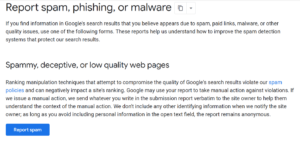
The language on the documentation page for Google Spam Manual Action has been revised, and the change matters. Google has removed the older disclaimer about reports not being used for direct action. The updated version now confirms that a Google spam manual action can stem directly from what someone submits through the reporting tool.
More specifically, Google has disclosed three important things about this new process:
First, if a report leads to a manual action, Google may pass your submitted text word-for-word to the website owner. That means whatever description or context you write in the open text field could be shown directly to the site being reported. Second, Google says it will not share any other identifying details about the reporter when notifying the site owner. Third, as long as you avoid including personal information in your submission, the report remains anonymous.
This is a material change, not a minor clarification. Reports that used to sit in a feedback queue may now trigger active enforcement.
Screenshot: Google’s Updated Report Spam Page
Why This Matters for SEOs Fighting Spam
Anyone working in SEO has seen it – sites built around link schemes, scraped content, thin affiliate pages stuffed with keywords, or doorway pages ranking for competitive terms. Competing against that kind of content while playing by the rules is frustrating, and for years there wasn’t much recourse outside of waiting for a core update to clean things up.
The ability to submit a report that could lead to a Google spam manual action gives the SEO community something more concrete. If you encounter a site that’s clearly gaming the system with ranking manipulation, you can now flag it through the official report spam page with a higher degree of confidence that someone might actually look at it.
That said, this isn’t a weapon. The process is still at Google’s discretion, and not every report will lead to enforcement. But the Google Spam Manual Action policy shift signals that Google is willing to be more aggressive about using human review alongside algorithmic detection.
What Stays the Same
The rest of the spam reporting page is unchanged. The actual submission form looks the same, and the categories of violations you can report, including ranking manipulation, scraped content, spam links, and structured data abuse – remain identical. The difference is purely in what Google may do with your input once it’s received.
It’s also worth noting that the wording uses “may,” not “will.” Google isn’t committing to reviewing every submission, but the door to a Google spam manual action based on user reports is now officially open.
How to Submit a Spam Report Correctly
If you want your report to be taken seriously, be specific. Describe the violation clearly, mention the type of manipulation you observed, and avoid vague language. Since your written description might be sent directly to the site owner if a manual action is issued, treat it like a professional complaint- factual, detailed, and free of personal information.
You can access the tool here: Google’s official report spam page.
This update fits into a broader pattern of Google tightening enforcement against search spam. Earlier this year, Google also introduced a new spam policy targeting back button hijacking – a tactic where sites prevent users from navigating away normally. And just weeks before that, the Google March 2026 Spam Update completed its rollout in under 24 hours, signaling that Google is increasingly willing to move fast on spam enforcement rather than waiting for large scheduled updates.
Whether these changes collectively make the SERPs cleaner over time remains to be seen, but the shift in spam report policy is a real one – and SEOs who’ve been frustrated by spam-heavy results now have a slightly more direct line to flag the problem.