
Google Sends Back Button Hijacking Warnings via Search Console
Site owners are waking up to a fresh wave of Search Console emails this week, and not the good kind. Google has started pushing out back button hijacking warning notices tied to its new back button hijacking spam policy, and if your inbox has one sitting there right now, you’ve got roughly six weeks to sort things out before enforcement kicks in.
The deadline is June 15, 2026. After that, Google says it may issue manual actions or trigger automated algorithmic adjustments against sites that are still messing with users’ browser navigation. That’s not a vague threat – it’s a concrete penalty timeline, and the SEO community is already paying close attention.
So What Exactly Is Back Button Hijacking?
It’s simpler than it sounds. When someone hits the back button on their browser, they’re expecting one thing: to go back to wherever they just came from. Back button hijacking breaks that expectation entirely. Instead of landing on the previous page, the user gets bounced somewhere else – a page they never asked to visit, an ad, a recommendation screen, or they just get stuck and can’t go back at all.
Google’s own definition puts it plainly: sites are hijacking the back button when they interfere with normal browser navigation and prevent users from immediately returning to where they came from. It’s a dark pattern, and Google’s decided it won’t tolerate it in Search results anymore.
The Warning Email: What It Says and What to Do
Glenn Gabe, a well-known SEO consultant, was one of the first to share a screenshot of the notice on X. “Google has started sending out emails to sites that are actively hijacking the back button,” he wrote. “It’s a warning with sample URLs, links to the blog post about the new spam policy, etc.”
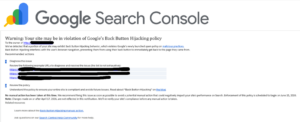
The email itself doesn’t pull punches. Here’s the core of what it tells site owners:
“We’ve detected that a portion of your site may exhibit back button hijacking behavior, which violates Google’s newly launched spam policy on malicious practices… No manual action has been taken at this time. We recommend fixing this issue as soon as possible to avoid a potential manual action that could negatively impact your site’s performance on Search.”
The email also lists specific example URLs where the back button hijacking behavior was spotted, though Google notes the list isn’t exhaustive. It’s a starting point for your audit, not a complete inventory of every problem page.
One Important Caveat on the Dates
Here’s something worth noting before you panic: Google has clarified that any changes made to your site on or after April 17, 2026 won’t be reflected in this current notification. The warning was generated from a crawl snapshot taken before that date. So if you’ve already cleaned things up recently, your fixes may not yet show in the system, but Google says it will re-verify compliance before actually taking any manual action.
That’s actually a reasonable safety net. It means you won’t be penalized purely on stale data. But it also means you shouldn’t use it as an excuse to sit on your hands – the June 15 enforcement date still stands.
How to Actually Fix Back Button Hijacking on Your Site
Start with the URLs Google flagged in the email. Open each one, try hitting your browser’s back button, and see what happens. If you land somewhere unexpected or get stuck, you’ve confirmed the problem on that page.
Technically, back button hijacking usually traces back to JavaScript misuse, specifically, scripts using history.pushState() or history.replaceState() in ways that stuff extra entries into the browser history. Third-party ad scripts, affiliate redirect tools, and certain pop-up or interstitial plugins are common culprits. Audit your JS, check your redirect chains, and strip out anything that deliberately manipulates the browser history stack.
Once you’ve made fixes, keep a record of what you changed and when. If Google re-verifies and still finds issues, having documentation of your remediation efforts is useful context.
We covered the full details of this policy when it first launched — read our earlier piece on Google’s new spam policy targeting back button hijacking for the complete breakdown.
The SEO Community Is Already Watching This Closely
Multiple SEOs have taken to X to share screenshots of clients and in some cases former clients who’ve received the back button hijacking warning notice. That tells you a couple of things. First, Google is sending these at real scale, not just to a handful of sites. Second, this isn’t necessarily limited to spammy or low-quality sites, legitimate businesses running certain types of redirect or ad tech could be caught up in this too.
The broader context matters here as well. Google has been tightening its spam policies steadily over the past couple of years, and back button hijacking fits squarely into a wider crackdown on manipulative UX patterns.
Bottom Line: Don’t Wait on This
If a back button hijacking warning landed in your Search Console, treat it seriously. Google’s given fair notice, provided sample URLs, and set a clear deadline. Six weeks isn’t a lot of runway, especially if the fix requires developer time and a thorough site audit. Get your team on it now, verify the fixes are in place well before June 15, and don’t assume a recent update automatically gives you a clean bill of health until Google re-crawls. And if enforcement does kick in, dealing with a Google spam manual action is far harder than preventing one.”
As Gabe put it bluntly after sharing the warning screenshot: take this seriously. Hard to argue with that.