
Google March 2026 Core Update Done, Search Console Bug Fixed & Mueller Calls Out Fake SEO Gurus
This past week in search was not about dramatic announcements or sweeping new features. It was about loose ends getting tied up, quiet bugs getting acknowledged, and one Google insider saying something that most honest SEO professionals already felt but rarely say out loud.
Here is everything that happened and what it means for your website.
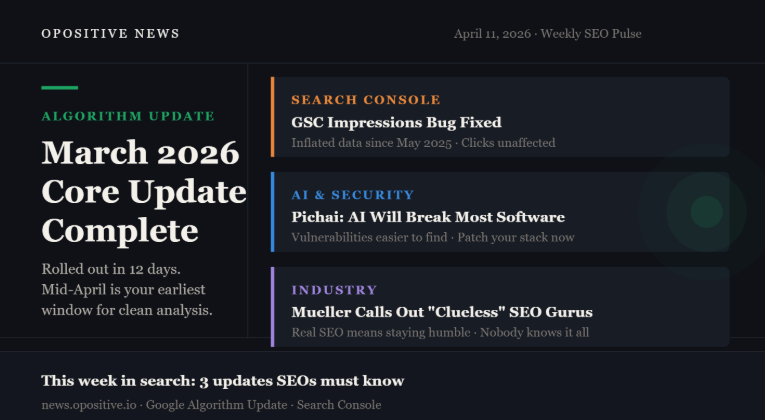
Google’s March 2026 Core Update Has Officially Finished
Google confirmed the March 2026 core update completed its rollout on April 8, 2026. It ran for 12 days from its March 27 start — faster than the December 2025 update, which stretched across 18 days, and comfortably within Google’s typical two-week window.
No blog post. No fresh guidance. Google described it as a routine update and moved on.
This was also the third notable update Google pushed in roughly five weeks. The February Discover core update and the March spam update both landed before this one, making it a particularly active stretch for the algorithm.
If your rankings shifted over the past two weeks, you now have a clean endpoint to work with. Google itself advises waiting at least one full week after a core update completes before drawing any conclusions from your data — which puts the reliable analysis window at mid-April at the earliest.
One thing worth keeping in mind: a ranking drop after a core update is not a penalty. These updates are Google re-evaluating content quality across the web as a whole. Pages move up, pages move down, and the process is rarely transparent.
Early observations from the SEO community suggest YouTube picked up significant visibility during this update period. A LinkedIn poll run by SEO consultant Aleyda Solís found that most respondents either saw positive movement or no noticeable impact at all.
A Search Console Bug Was Quietly Inflating Your Impression Numbers for Almost a Year
This one deserves your full attention if you have been reporting performance metrics to clients or stakeholders any time since last May.
Google acknowledged a logging error in Search Console that caused impressions to be over-counted starting May 13, 2025. The company updated its Data Anomalies page on April 3 to confirm the issue. Only impressions were affected — clicks, click-through rates, and positions remained accurate throughout.
The fix is currently rolling out, and you may notice your impression numbers drop noticeably over the coming weeks. That drop is not a sign of anything going wrong with your site. It simply reflects the correction of nearly 11 months of inflated data.
If your team has been presenting impression growth to clients since May 2025, it is worth revisiting those reports and adding context. Clicks remain the cleaner and more trustworthy signal while this correction works its way through the data. Mark May 13, 2025 as an annotation point in your reporting dashboards so anyone reviewing historical data understands the distortion.
Independent SEO consultant Brodie Clark flagged unusual impression spikes on March 30 — four days before Google publicly acknowledged the bug — noting the anomalies across merchant listings and image filter surfaces on several ecommerce accounts he manages.
If you want a deeper look at how Search Console data discrepancies have played out this year, our earlier coverage on the Google Search Console Links Report Showing Fewer Links walks through another recent data reliability issue worth reading alongside this one.
And if this update caught you off guard, our piece on Search Console Delays and How to Handle Performance Report Lag is a practical guide for building more resilient reporting habits going forward.
Sundar Pichai Believes AI Is Going to Break Most Software
In a podcast conversation with Stripe CEO Patrick Collison, Google CEO Sundar Pichai made a candid observation that went largely unnoticed outside tech circles but has real implications for website owners.
Pichai said AI is going to break most existing software, and framed software security as one of the underappreciated constraints on AI deployment alongside energy and memory supply. When investor Elad Gil mentioned that black market prices for software vulnerabilities were falling — a sign that AI is making them easier to find and manufacture — Pichai said he was not remotely surprised.
This is not a distant concern for SEO professionals. Websites run on software. If AI compresses the time between a vulnerability being discovered and it being exploited, the cost of running outdated plugins, themes, or dependencies gets significantly higher. Keeping your technical stack current has always been good practice. It is becoming more urgent.
Pichai’s comments were informal rather than a formal company position, but they came from someone who sits at the intersection of Google’s AI work and its security operations. They are worth taking seriously.
For context on how AI is reshaping search more broadly, our piece on Google Search Live Going Global covers how AI mode is already changing what users see when they search — and what that shift means for publishers.
John Mueller Has Something to Say About Anyone Who Calls Themselves an SEO Guru
Google’s John Mueller shared a blunt take on Bluesky this week after coming across a blog post by SEO professional Preeti Gupta, who wrote about how the word “guru” is being misused across the industry.
Mueller’s position was clear: if someone publicly labels themselves an SEO guru, treat it as a warning sign rather than a credential. SEO is not a belief system. Nobody has the full picture. The field changes constantly, and anyone who suggests otherwise is either overconfident or trying to sell you something.
Gupta’s original piece added a cultural layer that matters, particularly for audiences in India. The word guru carries deep spiritual significance in Indian tradition, and using it as a casual marketing label strips away that meaning in a way that many practitioners find genuinely disrespectful.
Mueller’s broader point — that honesty and continuous learning matter more than authority-signalling — is as relevant today as it has ever been. This week alone proved it. A core update completed without Google explaining what specifically changed. A Search Console bug ran undetected for nearly a year. The signals we rely on are imperfect, and treating any single methodology as settled truth is how mistakes compound.
If you want to understand how Google itself communicates about these updates, our breakdown of Why Google Core Updates Roll Out in Stages gives useful context on how these rollouts work and why the process is rarely clean or immediate.
What This Week Actually Means
Three things happened this week that have direct consequences for how you read your data, secure your site, and evaluate the advice you take from people in this industry.
Your Search Console impressions may have been wrong for nearly a year. Your rankings may have shifted because Google quietly recalibrated quality signals. And the people most worth listening to in SEO are usually the ones telling you they don’t have all the answers.
For a broader look at everything that moved in search this past month, our Google March 2026 Weekly SEO Roundup covers the full picture in one place.